- HX Daily
- Posts
- HX Weekly: October 12 - October 16, 2026
HX Weekly: October 12 - October 16, 2026
Anatomy of a Stock Market MELT UP

Hello reader, welcome to the latest issue of HX Weekly!
Each week we bring you a new edition of HX Weekly that includes three distinct sections.
In the first section, Thoughts on the Market, we'll offer insights into current economic and market news or timeless insights.
In the second section, HX Daily Redux, we'll revisit investing concepts, tactics, and more from past issues of HX Daily.
And in the third section, Market Wizard’s Wisdom, we’ll share thoughts, quotes, and theories from the greatest investing minds of all time.
Now, let's dive in!
Thoughts on the Market
Anatomy of a Stock Market MELT UP
Next year will officially mark my 30th year as a professional investor in the stock market.
Three decades is a long time – ha ha!
One observation that will surprise people is my answer when I am asked, “Enrique, what is the CRAZIEST period you have ever seen in the stock market?”
Well, those few weeks in March 2020 during COVID were pretty nuts!
I also remember very well where I was (landing at Chicago O’Hare airport) when the S&P 500 hit its low of 666 back in March 2009. It was cold…
Another memory that comes back is watching the second plane hit the World Trade Center on CNBC at my desk in September 2001.
There have been a lot of extreme moments over the years, but there is one…one that stands out well above all the rest.
THAT one is the 1999/2000 MELT UP in the NASDAQ.
Let me show you. Here is a chart of the NASDAQ from 1998 to April 2000…

1998 was a volatile, but fantastic year. The NASDAQ was +39%.
This was building upon some good years over the 1990s. The NASDAQ averaged almost +20% over that period.
1999 was also off to a great start. It was +35% by the end of October.
It was the start of November 1999 that everything went NEXT LEVEL.
The NASDAQ had gapped up on the last day of October.

That day Federal Reserve Chairman Alan Greenspan made remarks suggesting that the two rate hikes they had done prior in the year were enough. This led to bond yields dropping.
Randomly, that day also happened to be the 70th anniversary of the 1929 stock market crash.
Here is a chart from that day to the market peak in March of 2000. This chart shows the intra-day price movements of the index…

The green circle we have added shows that the index showed remarkably little volatility into year-end.
The difference between the high and low in the index intraday averaged 1.8% over those final two months of 1999.
Over that period, the NASDAQ was up an astounding +37% in just two months!
Now, here is chart highlighting the second half of this period…

During this period, though, there was a considerable pick up in volatility and several severe sell offs.
Intraday volatility went up 70% to 3.1% per day.
Those sell-offs highlighted on the chart averaged -7.6% over 4 days.
January 2000 alone had sell offs of -9.8%, -4.9% and -6.7%. All in one month!
Those are some huge moves.
The most remarkable aspect of this period?
Over the next two and one half months, the NASDAQ was up another +25%!
Even as fear picked up, the stock market continued to soar.
On Wall Street there is a saying for this phenomenon - climbing the “wall of worry.”
This is when fear and negative sentiment can fuel explosive moves higher in stock price.
This is particularly interesting to us right now.
After a strong move higher, the NASDAQ sold off -4.7% in just a few days.
Earlier this week, my girlfriend asked me a question I think a lot of you might be wondering.
“Do you think there could still be a melt up in the stock market? It doesn’t feel like it with all the fear out there and the sell-off in technology stocks.”
The answer is YES!
Do you want to know the most surprising part about that CRAZY period back in 1999 and early 2000?
The sentiment I remember most from that period was not excitement or greed.
Mind you, there was plenty of that.
Here is a chart showing one of the most popular investor sentiment indicators, the AAII Bullish Investor Sentiment poll, from that period…

It puts in its all-time high on January 6, 2000.
Now, the emotions that I felt most in the market at that time was…FEAR and CONFUSION.
Fear of missing out on the rally.
Fear of losing assets if you didn’t buy into this new world.
Fear that it wasn’t sustainable.
Confusion on how the market could be soaring with the Fed raising rates.
Confusion about the impossible valuations on the cutting edge companies.
Confusion because the math of the fundamentals of the stocks made no sense.
Sound familiar?
We honestly don’t know if we are going to see another stock market MELT UP like we saw back in 1999.
It may remain throughout the rest of my career, the CRAZIEST period I will ever see.
If we do, though, you need to be prepared!
Next week, we will share the playbook on how to take advantage of it AND how to protect yourself into the inevitable downturn.
Around this time last year, we wrote a note about the potential for an AI Bubble. As we enter into the final months of 2026, it feels like the we may be entering into the next stage of the AI boom.
We thought it would be good to share our perspectives from a year ago as we discuss our evolving thoughts in the coming months. Enjoy.
HX Weekly Redux
The AI Melt-Up: Boom, Bubble, or Something In Between?
Last week on CNBC, legendary investor Paul Tudor Jones sounded the alarm, predicting that U.S. stocks may be entering a “blow-off” phase.
In his appearance, Jones drew a parallel to the dot-com boom of the late 1990s and suggested that all the ingredients for a powerful, potentially explosive rally are falling into place.
He stopped short of predicting exactly how things will play out. But his message was clear: the market is shifting into a new and more volatile gear.
For investors, this raises a timeless question:
How do you navigate a market that looks like a bubble but refuses to pop, at least for now?
Making predictions in these moments is tricky.
It’s easy for commentators to hedge their bets by forecasting a sharp rally followed by an inevitable crash.
If stocks surge, they can claim victory.
If the market collapses, they’ll say they warned us.
But timing such turning points has always been more art than science, and often more luck than skill.
The Double-Edged Sword of the AI Spending Boom
This current AI boom isn’t happening in a vacuum.
Unlike past bubbles driven primarily by speculation, today's rally is underpinned by real economic activity.
The world's largest technology firms are pouring hundreds of billions of dollars into building AI infrastructure: data centers, chips, software platforms, and energy capacity.
Stargate Data Center – Abilene, TX
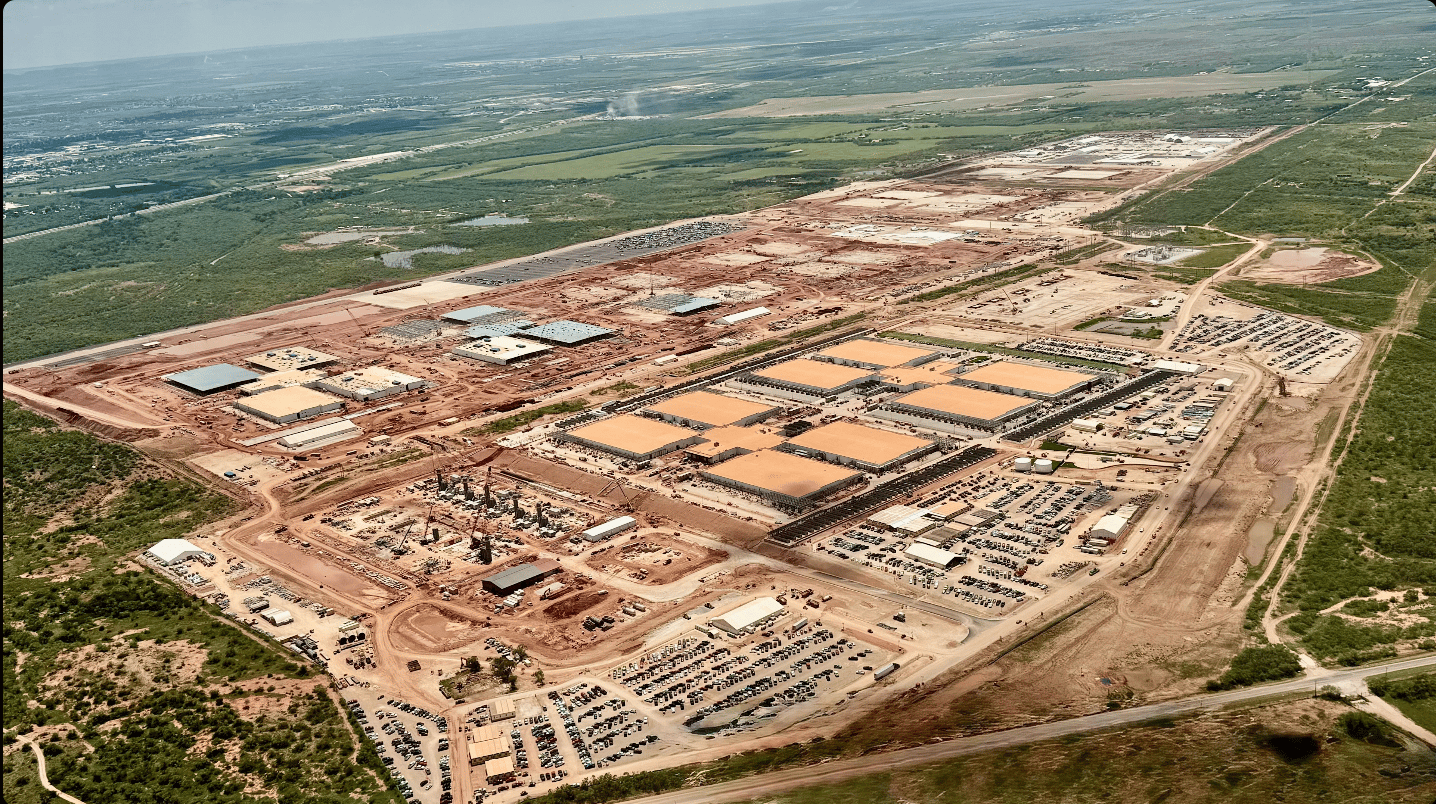
That flood of capital is transforming the stock market and the broader U.S. economy.
The scale is extraordinary.
A recent chart by economist Joey Politano illustrates how significant AI-related investments have become as a share of total U.S. economic activity.
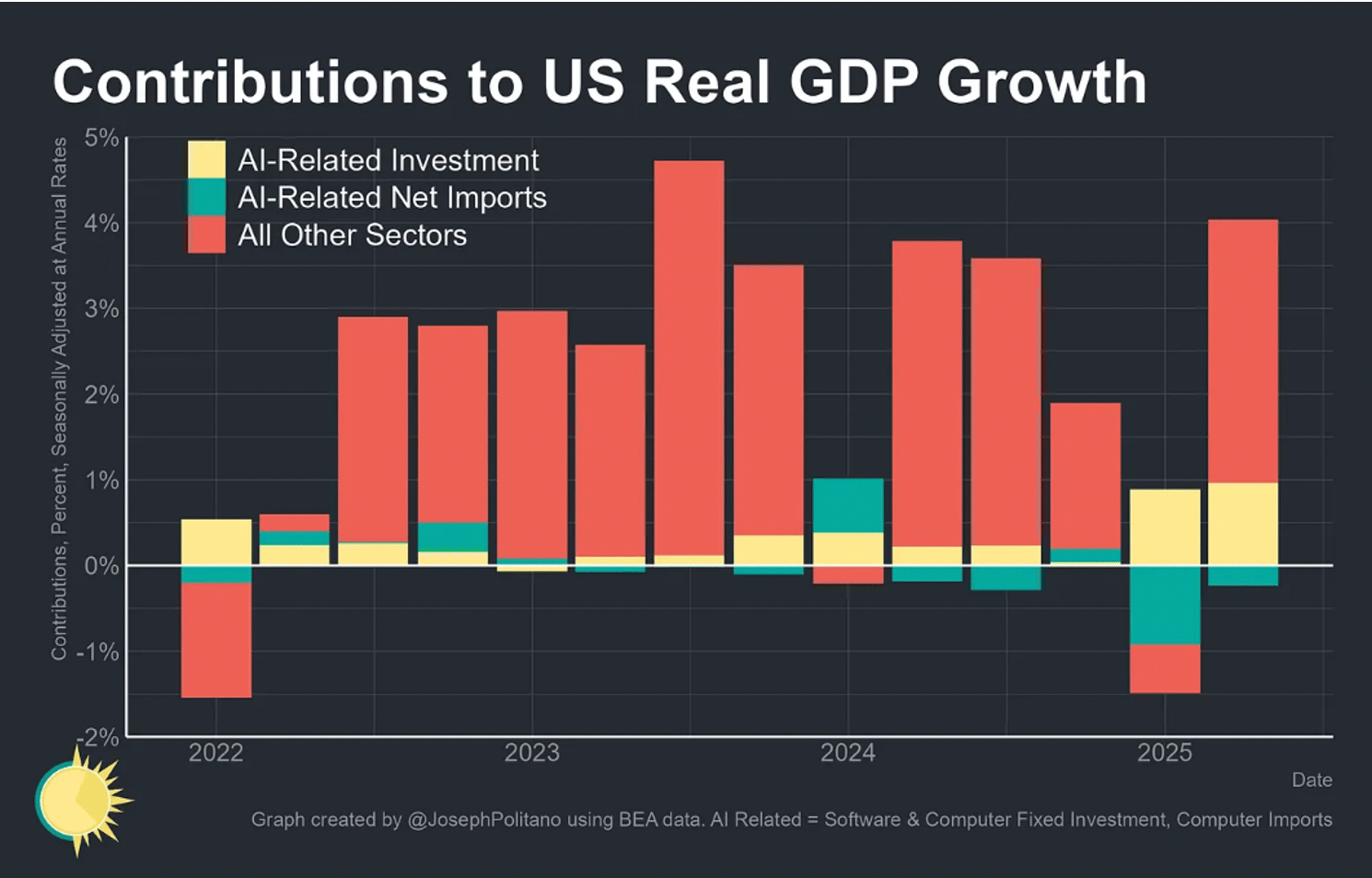
These aren’t marginal bets. They represent one of the most intense capital spending booms in modern history.
As a result, the AI surge is no longer just a tech story, it’s become an economic pillar supporting growth at a national level.
But what happens if that pillar wobbles?
Two broad scenarios emerge.
In the first scenario, the tech giants overshoot.
They spend far more than is needed, and the returns on those investments take years to materialize.
If that happens, the sector could face a brutal period of retrenchment, leading to a broader bear market.
In the second scenario, the investments pay off quickly.
AI makes companies dramatically more efficient and enables them to reduce costs. Cost cuts, which could include millions of white-collar jobs.
Ironically, the transition to an AI-driven economy that leaves many workers behind could be painful, too,
Either path carries risks.
The first could trigger an investment-driven recession. Meanwhile, the second path could spark social and employment shocks as businesses adapt to a leaner, AI-enhanced operating model.
And of course, there’s a wide range of middle-ground outcomes as well. But the key point is that AI is now so deeply intertwined with economic growth that a slowdown in AI spending could have ripple effects far beyond Silicon Valley.
Markets on Edge: Can Anything Fill the Gap?
For much of the past decade and a half, the U.S. economy has shown remarkable resilience.
Whenever one growth engine sputtered, another emerged to keep things moving.
When the pandemic hit, government stimulus and consumer spending took the lead.
When inflation surged and consumer demand cooled, AI spending increased to support growth.
But if this AI boom slows sharply, what could take its place?
Housing might be one candidate. If mortgage rates fall enough, the real estate market could stage a resurgence, providing a new source of momentum.
But that’s far from guaranteed.
For now, both the stock market and the broader economy appear heavily reliant on the continued strength of AI investment.
Why Calling the Top Is So Hard
Of course, many investors wonder whether we're nearing the end of this remarkable cycle.
Are we in the eighth or ninth inning of the game?
History offers little comfort.
One chart tracking the forward price-to-earnings ratio of the S&P 500 since 1990 shows that markets have peaked at widely varying valuation levels before every major downturn.
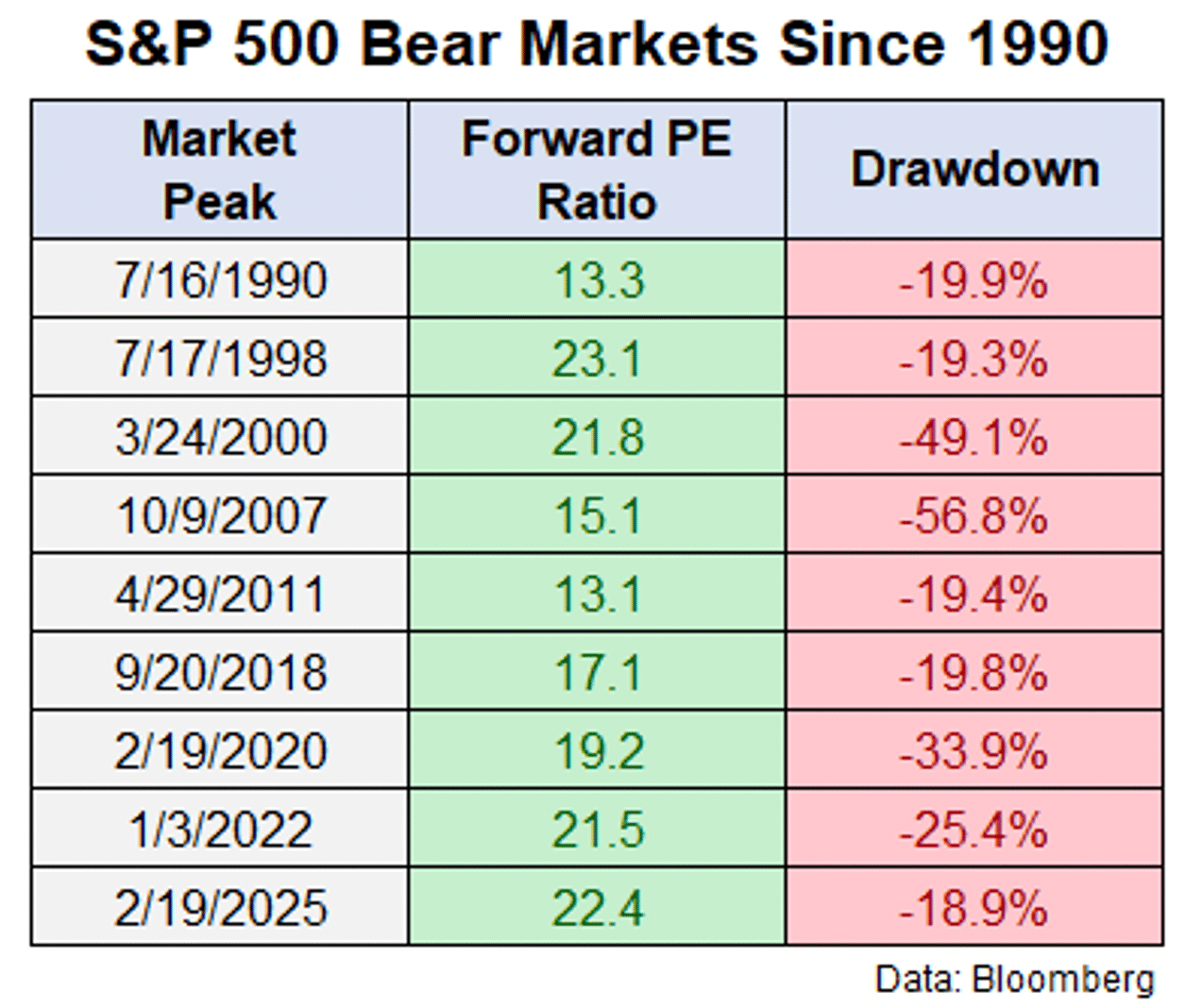
Sometimes valuations soar well above the historical average of roughly 16.5 times earnings before a correction hits.
At other times, markets have rolled over from below-average levels. There’s no single line in the sand that signals the top.
Historically, investors who tried to call the top too early often missed out on substantial gains before the eventual collapse.
It’s a reminder that markets during innovation booms are driven less by numbers and more by narratives, emotions, and fear of missing out (FOMO).
Prepare, Don’t Predict
So, what should investors do?
The uncomfortable truth is that no one can consistently and accurately predict when a market cycle will end.
Anyone who gets it right once is more likely lucky than prophetic and will most likely never replicate that success.
Every boom eventually runs its course, but the timing is unknowable.
In such moments, wise investors should prepare for a broad range of outcomes rather than placing all their chips on a single prediction.
Rather than obsessing over the exact timing of the top, investors may be better served by diversifying, maintaining discipline, and staying focused on fundamental trends.
Whether this AI boom ends with a bang or a smooth landing, the shift it represents is real.
Its impact on both markets and the economy will reverberate for years to come.
Market Wizard’s Wisdom
The Master of the Citadel
There have been several Money Masters over the years on Wall Street.
Go back to the “Roaring ‘20s” and you will read about Jesse Livermore, Benjamin Graham, and Joseph Kennedy.
The “Go Go ‘60s” had gunslingers like Gerald Tsai, Fed Carr, and T. Rowe Price Jr.
Going into the 1980s and 1990s, we saw the rise of the first group of hedge fund wizards including Julian Robertson, George Soros, Paul Tudor Jones, and Bruce Kovner.
Over the last few decades, we have seen a new group emerge.
They came from varied backgrounds, but they have been the architects of the “multi-strategy” hedge fund giants that dominate the capital markets today.
One of the largest, and perhaps most famous, of this group of Modern Money Masters is Ken Griffin, the founder of $77 billion hedge fund Citadel LLC.

Griffin was born in Daytona Beach, Florida on October 15, 1968.
He began his investing career early while still an undergraduate at Harvard University. That is where he launched his first fund from his dormitory room at the age of nineteen.
Griffin began his career by focusing on the obscure market for convertible bonds.
These are securities that involve a “bond” that can be converted into equity. This creates a structure that is a bond and an equity called an option.
He was not the first to understand this structure, but he was one of the first to apply advanced quantitative and computer modeling to valuing these securities.
This led Citadel to become one of leaders in the field of “convertible arbitrage.”
In the early days of this strategy, the returns were fantastic with low risks. Over the years, he leveraged the great track record he built in this field to diversify into other strategies.
This is how Citadel moved from a convertible arbitrage fund to become a “multi-strategy” fund.
Griffin’s passion for winning has not only transformed Citadel into one of the biggest hedge funds in history, but also one of the largest operators in the financial markets. They now handle almost 25% of all US equity trades overall and 40% of retail stock trading.
Like them or loathe them, Citadel and Griffin are a major force in the financial markets.
Today, in honor of his 58th birthday, we share some of his wisdom over the years.
“Don't play to win —play to win by a landslide.”
This quote sums up a lot about Ken Griffin.
He is not only looking to win…he is also looking to dominate!
There is an analogy in investing.
Why look for 30% returns, when you can look for 300% returns?
This is something we often emphasize in long-term investing.
“If you're not passionate about the field, you're engaged in you won't have the grit or perseverance to compete with those who are.”
Griffin is obviously a passionate guy. This is what has helped propel him to massive success.
We don’t all have to be as passionate in our careers.
To be the best, though, it is necessary.
The good news is that in your trading and investing you don’t need to compete with Griffin. You just need to be good.
A passion for the challenge is helpful.
“Learn from those who have more years of experience. You have no idea how many hours a day I spent on the phone — like a sponge —learning about finance from those with 15, 20, 25, 30 years of experience.”
This is one of my favorites.
When I ran my hedge funds, I made a point of ALWAYS taking meetings with the older Wall Street sell side analysts.
My younger analysts would tell me it wasn’t worth our time, that these analysts were not as in touch as their younger colleagues.
I pointed out to them that they had experience those other analysts would not have for decades.
Today I still do this and go out of my way to talk to those with decades of experience.
There simply is no substitute for it.
“You can't succeed in the markets today unless you are part of a great team. The team is the essence of how you win.”
This is another difficult lesson for younger people to understand.
You are going to have more success individually as part of a team than on your own.
That is one of the reasons we launched HX Research, to build a team and community for individual investors. So, we can all win together!
“Those who have enjoyed the benefits of our system more than ever now owe a duty to protect the system that has created the greatest nation on this planet.”
Griffin does an excellent job of sharing insights that younger people often don’t understand. This is another one.
First, it is difficult for most to acknowledge that our great country and our system is what enables so much of our individual success.
Second, it is also hard to step up and understand that this system survives (and thrives) because we work to defend it and expand it.
We write our newsletters as part of our efforts to play our part.
We would ask each one of you to think about what you can do on your part.
We hope that you’ve enjoyed this week’s issue of HX Weekly…
What did you think of today's HX Weekly?Your feedback helps us create the best newsletter possible. |
Do you have any thoughts, questions, or feedback? Tell us more in the comment section or at [email protected].
Reply