- HX Daily
- Posts
- HX Weekly: April 6 - April 10, 2026
HX Weekly: April 6 - April 10, 2026
Stormy Waters Create Strong Returns

Hello reader, welcome to the latest issue of HX Weekly!
Each week we bring you a new edition of HX Weekly that includes three distinct sections.
In the first section, Thoughts on the Market, we'll offer insights into current economic and market news.
In the second section, HX Daily Redux, we'll revisit investing concepts, tactics, and more from past issues of HX Daily.
And in the third section, Market Wizard’s Wisdom, we’ll share thoughts, quotes, and theories from the greatest investing minds of all time.
Now, let's dive in!
Thoughts on the Market
The Market’s Most Misunderstood Pattern
Every cycle has its moment of maximum fear. The headlines get louder. The forecasts get darker. And the average investor starts to believe that “this time is different.”
We’re in one of those moments right now.
Turn on any financial network or scroll through your news feed and you’ll see the same themes repeating: geopolitical instability, war risk, supply chain disruption, energy shocks, political uncertainty.
The narrative is familiar, and it’s designed to make you feel like stepping aside is the prudent move.
But history tells a very different story.
What Happens After the Fear Peaks
On the one-year anniversary of “Tariff Liberation Day,” a chart we’ve been reviewing this week tracks S&P 500 performance in the 12 months following major geopolitical events going all the way back to the Korean War.
We saw the chart on Monday in an X Post from one of our favorite finance writers, Ben Carlson. If you’re not already following him, we recommend it, and you can do so here.
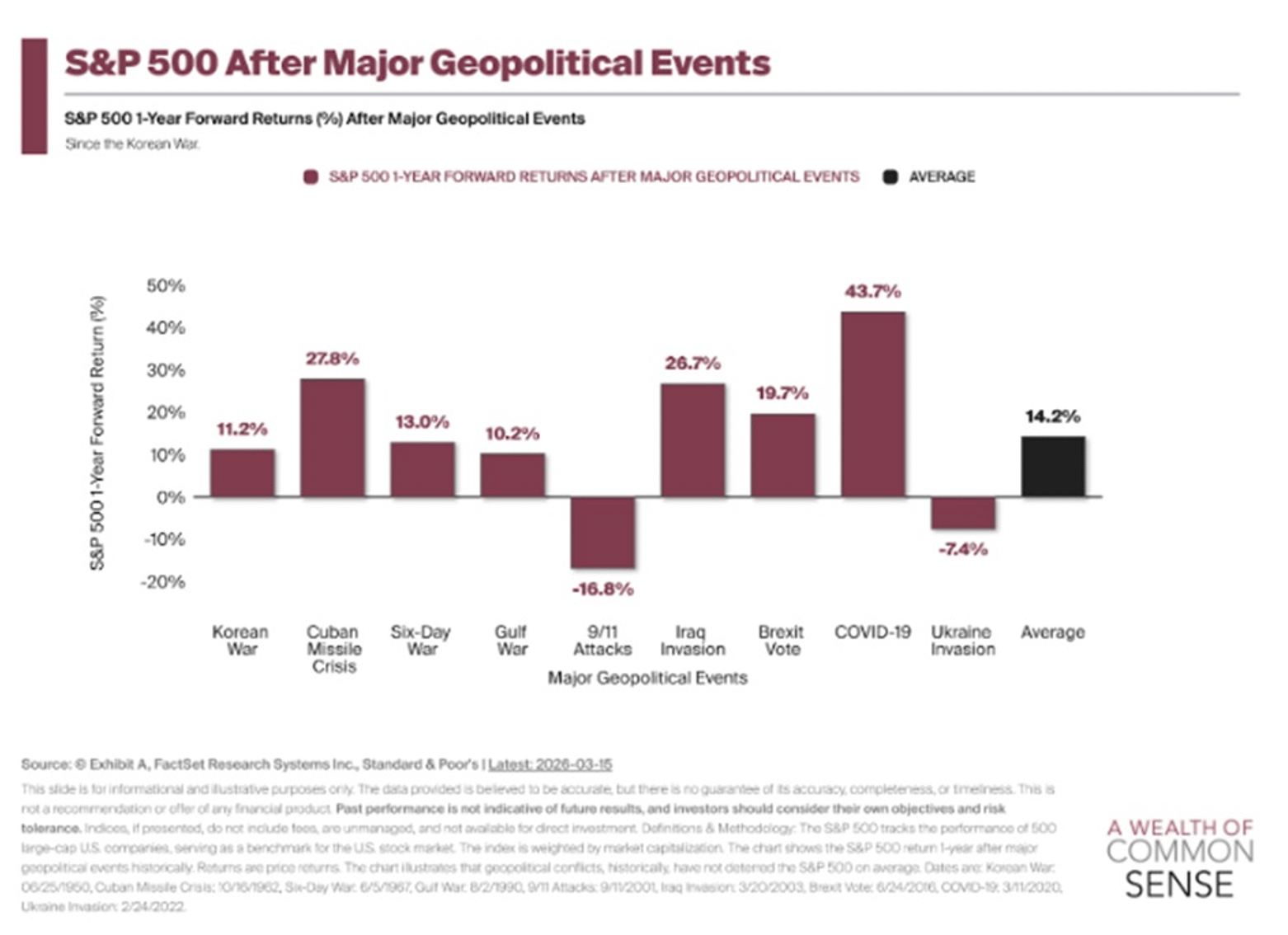
As you can see, the events this graphic displays are not minor headlines.
We’re talking about moments that genuinely shook the global order. Wars, terrorist attacks, economic shocks, and even a once-in-a-century pandemic.
And yet, when you zoom out and look at what actually happened next, the results are striking.
On average, the S&P 500 has delivered a 14.2% return in the year following these events.
Let that sink in for a moment.
Not flat. Not slightly positive. But a strong, double-digit return on average after periods that felt, in real time, like the world was coming apart.
Even more telling is how often those gains were substantial:
· After the Cuban Missile Crisis, markets moved nearly 28% higher over the following year.
· After the Iraq invasion, nearly 27%.
· Following Brexit, a political shock that many believed would fracture the global financial system, the market climbed almost 20%.
· And after COVID-19—arguably the most disruptive global event of our lifetime—the S&P 500 surged over 43% in the year that followed.
The Exceptions That Prove the Rule
Now, to be fair, this pattern is not perfect. There are exceptions.
After 9/11, markets declined meaningfully over the next year. The Ukraine invasion also produced a negative forward return.
It’s worth noting, that unlike the other events listed, the Fed was actively raising interest rates around the 9/11 and Ukraine invasion timeframes.
But those instances are the minority, not the rule.
The broader takeaway remains intact.
Markets tend to perform best not when the world feels safe, but when uncertainty begins to clear.
The Market Doesn’t Price Events - It Prices Uncertainty
That distinction is critical, and it’s one of the most misunderstood dynamics in investing.
The market is not a scoreboard of current events. It is a forward-looking mechanism that constantly prices in expectations about the future. And what it hates more than anything else is uncertainty.
When uncertainty is high, investors demand a higher risk premium. That shows up as lower stock prices.
But once an event actually occurs, no matter how negative, it begins to shift from the unknown into the known.
The range of possible outcomes narrows. Visibility improves. And capital starts to move back into the market.
In other words, the market often bottoms not when the news turns good, but when the uncertainty stops getting worse.
March 2020: The Perfect Case Study
You’ve seen this play out over and over again.
In March of 2020, as lockdowns spread and fear peaked, markets collapsed at one of the fastest rates in history.
But the bottom didn’t come when the virus disappeared. It came when investors could begin to model what the future might look like, however imperfectly.
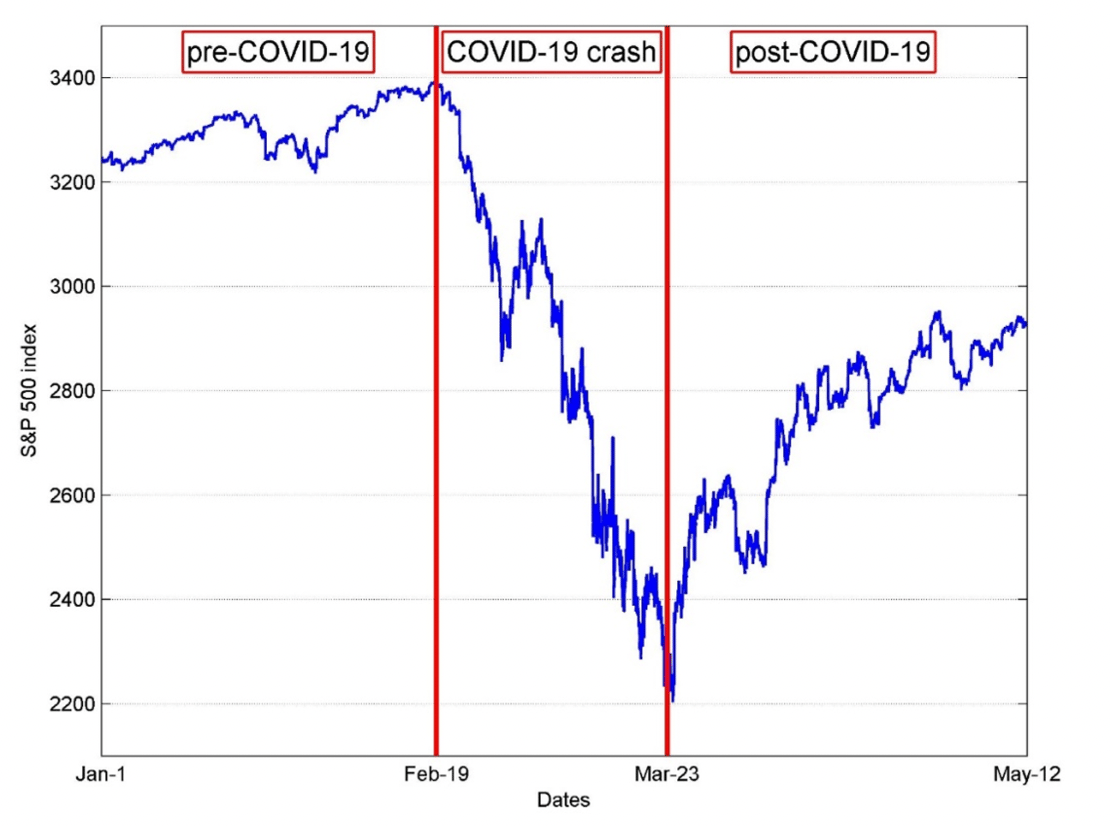
From that point forward, stocks moved sharply higher despite a steady stream of negative headlines.
The same pattern showed up in 2003 during the Iraq War, in 2016 during Brexit, and in countless other moments that felt, at the time, like reasons to stay on the sidelines.
Why Most Investors Get This Wrong
This is where most investors make their biggest mistake.
They wait for clarity. They wait for the headlines to improve. They wait for the risk to “go away.”
But by the time that happens, the market has already moved.
What these charts reinforce, and what decades of market history confirm, is that periods of geopolitical stress often create opportunity, not because the events themselves are positive, but because they temporarily distort pricing.
Fear compresses valuations.
It forces selling.
It creates dislocations between price and long-term fundamentals.
And for investors willing to step back and look beyond the immediate noise, those dislocations can be incredibly valuable.
Positioning > Headlines
It also reinforces something we talk about frequently in HX Weekly: short-term moves are driven by positioning, not just fundamentals.
When everyone is leaning the same way, when sentiment is overwhelmingly negative and portfolios are defensively positioned, it doesn’t take much of a shift in expectations to drive a meaningful move higher.
That’s how you get powerful rallies in environments that still feel fundamentally uncertain.
And that’s exactly the kind of setup we’re seeing today.
The Opportunity Hidden in Plain Sight
The headlines remain volatile. The macro narrative is still unsettled.
But beneath the surface, positioning has adjusted. Expectations have been reset. And the market is beginning to process not just what’s happening now, but what comes next.
That’s where the opportunity lies.
Because if history is any guide, and it often is in these situations, the period of maximum discomfort is not the end of the story.
It’s the setup.
The Bottom Line
The investors who tend to benefit the most are not the ones who react to fear, but the ones who understand how the market behaves around it.
They recognize that uncertainty is temporary, that pricing adjusts quickly, and that the biggest moves often begin when conviction is hardest to find.
Right now, we are once again being presented with that choice.
You can follow the headlines and wait for things to feel better.
Or you can recognize the pattern that has repeated itself for over half a century and position accordingly.
Because the market has made one thing very clear over time.
It doesn’t reward comfort.
It rewards conviction at the moments when it’s hardest to have it.
Below is the note we published in HX Weekly almost exactly one year ago. You might remember that it was when we were in the heart of the "Trump Tariff Tantrum" and the markets were swinging wildly.
We like to visit our writings from a year earlier to get perspective on today. Funny enough the environment right now shares a lot in common with back then!
While the "3.5% rule may not be in action right now, it is a good one to keep in your back pocket. Enjoy the look back!
HX Daily Redux
It’s Time to Get Tactical
As we all know by now, on Wednesday, President Trump announced a slate of universal tariffs that were far more aggressive than anybody anticipated.
Wow!
This has been a crazy week in the markets—a historically crazy week.
On Wednesday, Wall Street rallied to a record one-day points increase after President Trump announced a 90-day pause on implementing a new tariff regime except for China.
In fact, by the end of the trading day on April 9:
The S&P 500 was up 474.13 points, or 9.5%, its biggest percentage rise since March 2020.
The Nasdaq Composite rose 1,857.06 points or 12.2%, the biggest percentage gain since January 2002.
The Dow Jones industrial average finished up 2,962.86 points, or 7.9%.
This trading action came after a rapid decline in the market the previous week. In fact, between Thursday, April 3, and Friday, April 4, 2025, the three major U.S. stock indices experienced historic declines:
The S&P 500 fell 10.5%, marking the fourth-largest two-day drop since World War II.
The Dow Jones Industrial Average declined over 300 points during the same period.
The Nasdaq Composite entered a bear market, indicating a decline of 20% or more from recent highs.
So yeah, we just lived through market history twice in less than a week.
As we write this on Thursday afternoon, the indices are experiencing another major decline, with each down by over 5%.
What’s clear is twofold…
First, the stock market uptrend that we’ve been in is broken. Only time will if we’ve entered a period of consolidation or a new downtrend.
Second, the tariffs and reactions to them are generating a tremendous amount of market volatility.
That said, when there is chaos in the markets, it’s important to take a deep breath and remember that this is not the first time or the last time the markets have experienced choppy waters.
To study history is to know that the stock market’s largest single-day moves higher have all happened during these violent phases of volatility.
Thus, the market moves we witnessed on Wednesday are not unique, as evidenced in a post on X by Enrique Abeyta.

As you can see in the chart above, extreme up days are often immediately followed by big down days. So the market chaos that we're going through is, in fact, the norm.
And within chaos, there is an opportunity to make outsized returns.
So, it’s time to get tactical and make some money…
Whether you are fully or partially invested or 100% in cash on the sidelines, the time for action is now!
Moving forward, until the market establishes a new trend, we recommend employing the “3.5% rule”.
To apply this rule to your trading, divide your trading portfolio into several equal portions—say, six to eight "units."
On any day the S&P 500 drops by -3.5% or more, you use one "unit" to buy. On any day the market rises by +3.5% or more, you sell one "unit."
So, in the context of this week, on Wednesday, when the S&P spiked above +3.5%, you should have sold one "unit" of your trading portfolio to lock in some gains. On the contrary, when the market was down over -3.5% on Thursday, you would have bought a "unit."
If you have a more extensive portfolio, with maybe twenty holdings, you could double down on selling "units" on up days. Stick to buying one "unit" on down days, however.
The goal of the "3.5%" rule is to be systematic about your trading and remove emotion from the process. This type of tactical trading would have worked in every historical situation highlighted in the chart above.
No matter your current situation, aim to get to 30% to 50% invested as your base. Remember, we always want to have some cash on hand so we can act quickly should other opportunities arise.
So traders, it's time to lock in, pay attention to the market and make some money!
Market Wizard’s Wisdom
William O’Neil
A few investors and writers have had an outsized influence on our investment philosophy.
The most important of those by far is William O'Neil. In fact, his wisdom is so impactful that it's built into the underpinnings of our algorithmic trading platform, Signal Trader Pro.

O'Neil was born in 1933 in Oklahoma City and grew up in Texas, where he studied business at Southern Methodist University and served in the United States Air Force.
He began his career on Wall Street at stockbroker Hayden, Stone & Company and was one of the first to use computers in developing an investment strategy. At 30, he founded his own company – William O'Neil + Co. Inc. – and bought a seat on the New York Stock Exchange.
His company developed the first computerized daily securities database and pioneered quantitative analysis of stocks. He eventually launched a business newspaper, Investor's Business Daily, and authored several books.
The most famous of these books is "How to Make Money in Stocks," published in 1988. If there were one book we could recommend on investing it would be THIS book.
O'Neil's system (called "CANSLIM") encapsulates what we consider the best and most successful investment strategies.
Now, given the chaotic nature of the market this week, we decided to share some of O’Neil’s best-known quotes to shed perspective and refocus our attention on the big picture.
Here are three quotes from O’Neil that capture some of his wisdom…
“A great trader once noted there are only two emotions in the market: hope and fear. “The only problem,” he added, “is we hope when we should fear, and we fear when we should hope.” This is just as true in 2009 as it was in 1909.”
We think this quote is especially meaningful given the extreme tariff-driven fear in the markets this week. What we like about this quote is O'Neil's insight that the markets don't really change. As long as we have human beings actively involved in them, we will have emotions play a role.
“The moral of the story is: never argue with the market. Your health and peace of mind are always more important than any stock.”
Like the quote above, this wisdom is essential during weeks like this. Sometimes, when market chaos reigns and everything feels uncertain, you need to understand that the best thing to do is probably nothing. Focus on your health, family, etc.
O'Neil also captures the critical role of your frame of mind. Mastering your psychology and putting yourself in a position to win is an absolute must to be a successful investor.
“At least 50% of the whole game is in the general market.”
This is literally the most crucial aspect of trading and one that very few investors acknowledge.
The existing stock market environment will drive the majority of the short-term price action.
As a trader, you can make money in both BULL and BEAR markets, but the strategy will be different.
Both types of markets persist for a while and create well-established trends.
The FIRST decision you must make every day when trading is to decide what type of stock market environment we are in at THAT moment.
We hope that you’ve enjoyed this week’s issue of HX Weekly…
What did you think of today's HX Weekly?Your feedback helps us create the best newsletter possible. |
Do you have any thoughts, questions, or feedback? Tell us more in the comment section or at [email protected].
Reply